Vampire Survivors Gives You Nothing — Then Takes Hours
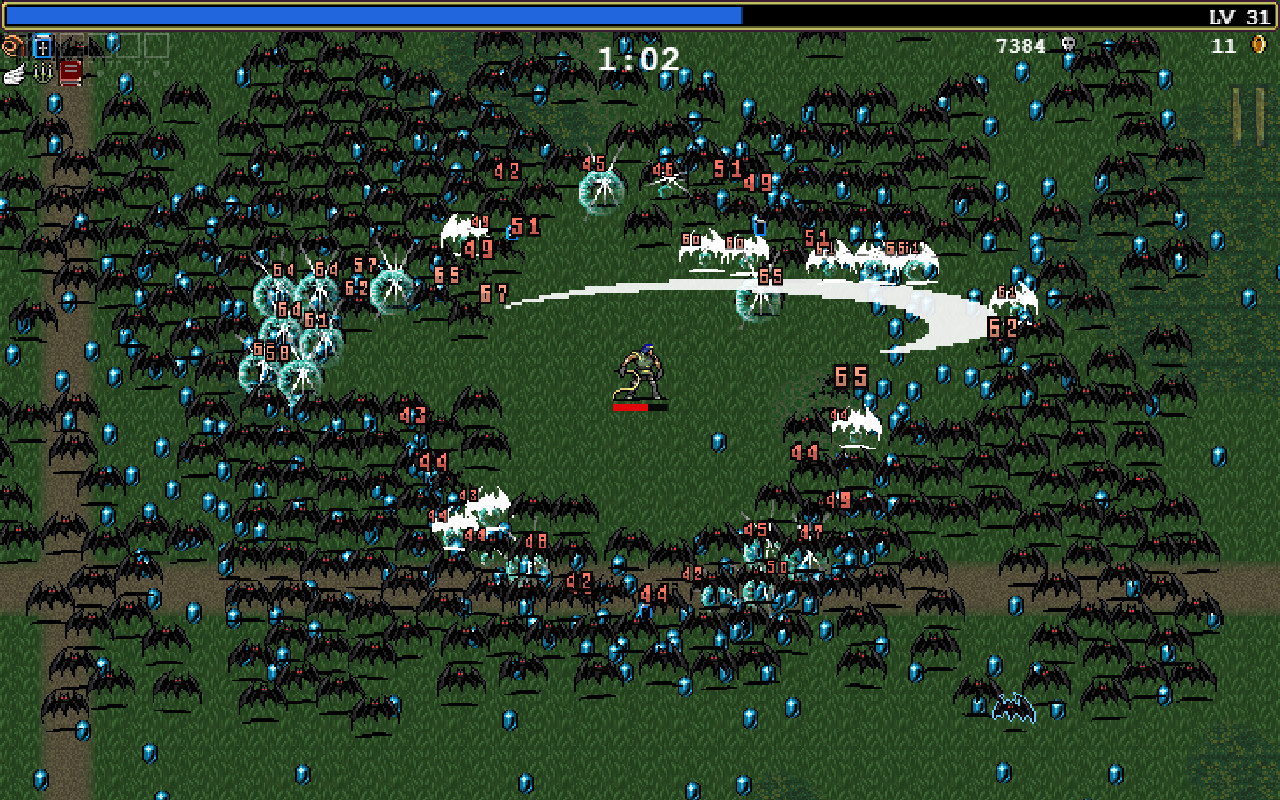
Vampire Survivors does not explain itself. There is no tutorial popup telling you which weapon combos unlock evolutions. There is no difficulty selector asking how much punishment you want. You get a character, a field full of enemies, and a clock counting up toward thirty minutes. The game&#folio-qpuh-gsnf;s implicit contract is simple: figure it out, or don&#folio-qpuh-gsnf;t.
That opacity is not a flaw so much as a design philosophy. Poncle — the one-person studio behind the game, primarily the work of developer Luca Galante — built something that rewards curiosity over hand-holding. It is also, depending on your patience, either the most compulsive few dollars you will spend on Steam or a game that will sit uninstalled after forty minutes. The split is real, and it is worth being honest about which side you are likely to land on.
What the Game Actually Is
Vampire Survivors is a passive action game — a subgenre it arguably created, or at least popularized beyond the flash-game era. Your character moves. Everything else is automatic. Weapons fire, rotate, or pulse on their own timers, and you spend each run picking upgrades from a small random selection that appears on level-up. The goal is survival. The mechanical question is which weapons synergize, which passive items amplify which active ones, and how to reach the thirty-minute mark without being swamped.
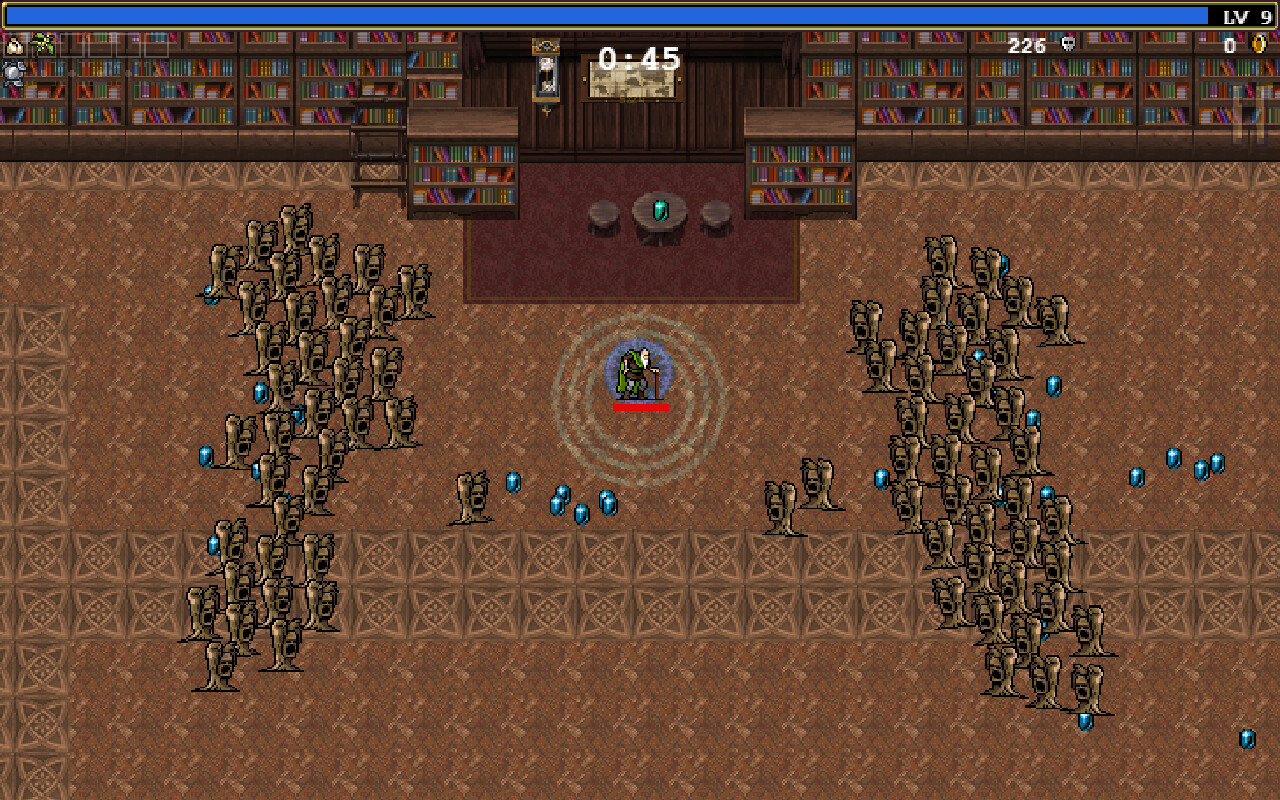 Scene from Vampire Survivors.
The evolution system is where most of the depth lives. Certain weapons, when leveled to maximum and combined with a specific passive item, transform into something significantly more powerful. The whip becomes the Bloody Tear. The magic wand becomes the Holy Wand. These are listed nowhere in-game unless you find the in-menu bestiary, and even then the information is sparse early on. Discovering combinations through experimentation — or through one failed run that nearly got there — is genuinely satisfying in a way that a tooltip would ruin.
The Loop That Makes You Stay
A single run lasts at most thirty minutes, usually less until you understand what you are doing. That brevity is doing a lot of structural work. The game does not demand large blocks of time, which means a failed run carries almost no friction. You died at twelve minutes. Fine. Start again. Try the knife build this time. The cost of experimentation is low enough that the game starts to feel like a testing environment rather than a punishment system.
Between runs, a persistent currency called gold coins feeds into an upgrade menu that increases base stats, unlocks new characters, and opens additional stages. This layer gives each run some forward momentum even when you are not clearing the timer. It is a modest system — nothing with the crafting depth of something like Hades, where Supergiant spent considerable effort making the meta-progression feel narratively integrated. In Vampire Survivors, the meta-layer is unapologetically mechanical. Numbers go up. Characters unlock. That is the offer, and it is enough.
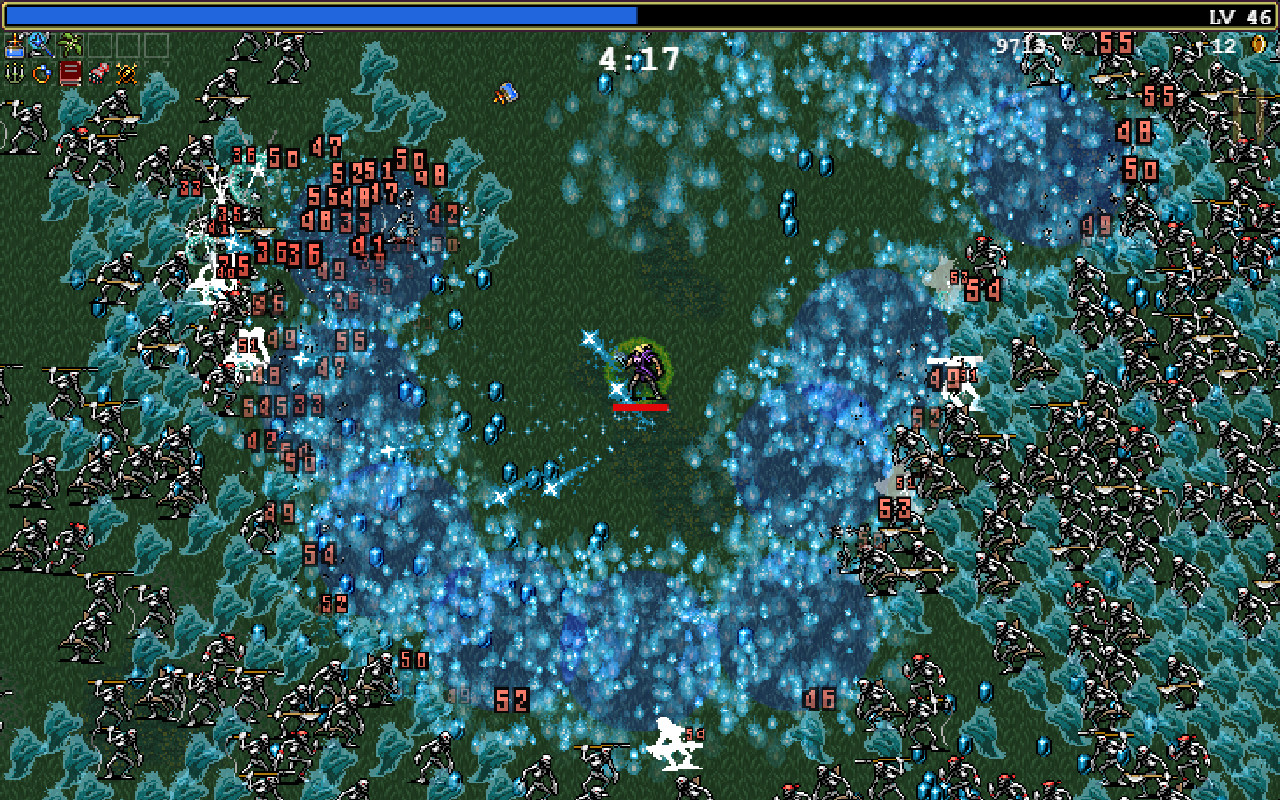 Scene from Vampire Survivors.
Where the Rough Edges Show
The game&#folio-qpuh-gsnf;s minimalism is a genuine strength until it isn&#folio-qpuh-gsnf;t. Some characters unlock after you meet specific in-run conditions that the game communicates through a vague achievement description at best. A few unlocks require you to perform actions you would have no reason to attempt without outside guidance. This is fine if you are the kind of player who enjoys community wikis and treats FAQ pages as part of the experience. If you are not, a handful of characters may stay locked indefinitely, which is a mild but real problem given that some of them are tied to significant build variety.
The stage design is the other place where the seams are visible. The opening area, a scrolling field called Madhouse, does a clean job of introducing the loop. Later stages introduce layout gimmicks — bounded arenas, scrolling directions, environmental hazards — but the differences rarely feel like they change strategic priorities in the way that, say, different maps in Risk of Rain 2 redirect how you think about item selection and movement. In Vampire Survivors, most of your decision-making happens at the level-up screen rather than in response to the terrain. The stages feel like backdrops more than systems.
The Price of the Power Fantasy
There is a specific moment in most Vampire Survivors runs — usually somewhere between the fifteen and twenty-five minute mark, assuming the build is working — where the screen becomes a wall of projectiles, lights, and enemy corpses. Your character is essentially invincible. Hundreds of enemies die per second. The game becomes a light show with a win condition attached. Some players find this transcendent. Others find it boring.
Personally, I found the mid-run power curve more interesting than the endgame. The early minutes, when resources are scarce and every level-up choice matters, have a quiet tension that the late-game buries under spectacle. The game is aware of this to some degree — the thirty-minute mark triggers a specific event designed to end the run if you have not already won — but it does not really solve the pacing problem so much as put a hard stop on it. That is a workable solution. It is not a satisfying one.
The DLC and What It Adds
Vampire Survivors has released paid expansions since its initial launch, adding characters, stages, and weapons. They are priced low enough that the question of value is almost beside the point — the additional content meaningfully extends the build variety, and some of the new weapon evolutions introduced are among the most visually entertaining in the game. None of it fundamentally changes the structure, which is either reassuring or disappointing depending on what you wanted changed.
The Legacy of the Moonspell expansion, set in a Japanese-influenced stage, is probably the most cohesive piece of additional content in terms of aesthetic consistency. The base game&#folio-qpuh-gsnf;s visual identity is deliberately retro and crude — pixel art that leans into its own limitations — and most of the expansions share that aesthetic without much friction. The new characters added across the various expansions also tend to have more defined mechanical personalities than some of the base roster, which is worth noting if you have been playing for a while and find the early characters underdistinguished.
Who This Game Is For
Vampire Survivors rewards a particular kind of player: someone who enjoys optimization for its own sake, is comfortable doing their own research, and finds something satisfying in passive systems that scale to absurdity. It is much closer in spirit to an idle game than to a twitch-action roguelite like Dead Cells or Returnal. Your fingers do not need to be fast. Your tolerance for repetition does.
If you go in expecting moment-to-moment skill expression — the kind you get from parrying in Sekiro or managing resources in Into the Breach — the game will feel shallow. That comparison is not entirely fair, because shallow is not the same as simple. But it is the comparison players will make, and Poncle has never pretended otherwise. The game knows what it is.
Vampire Survivors earns its reputation. It also earns its ceiling. Somewhere around the thirty-hour mark, depending on how much of the unlock list you are chasing, the marginal return on a new run starts dropping. The game does not evolve to meet you there. It just sits, patient and complete, waiting to see if you have one more run in you. Usually you do. That is probably enough.
Editorial scoring
Reader Q&A
How long does it take to finish Vampire Survivors Gives You Nothing — Then Takes Hours?
Main story runs around 85 hours depending on how thoroughly you explore. Completionists can spend 2-3× that.
Is Vampire Survivors Gives You Nothing — Then Takes Hours good for newcomers to Roguelike Auto-shooter?
Yes — Vampire Survivors Gives You Nothing — Then Takes Hours is a great entry point. The early hours teach the systems gradually and the difficulty curve is reasonable.
Which platform should I play Vampire Survivors Gives You Nothing — Then Takes Hours on?
Steam Deck handles this title well — verified compatibility on most recent patches.
Was Vampire Survivors Gives You Nothing — Then Takes Hours worth the launch-day price?
Depends on backlog. The replay value justifies the price for genre fans; casual players should wait for a 40%+ discount.
Are there DLCs or expansions worth picking up?
Wait for the Game of the Year edition — it bundles everything at a fair discount.
What did Poncle get right (and what could be better)?
The systems are confident and the combat is satisfying. The story handoffs and load times are the rough spots.