Your Dynasty, Your Disaster: CK3 Reviewed
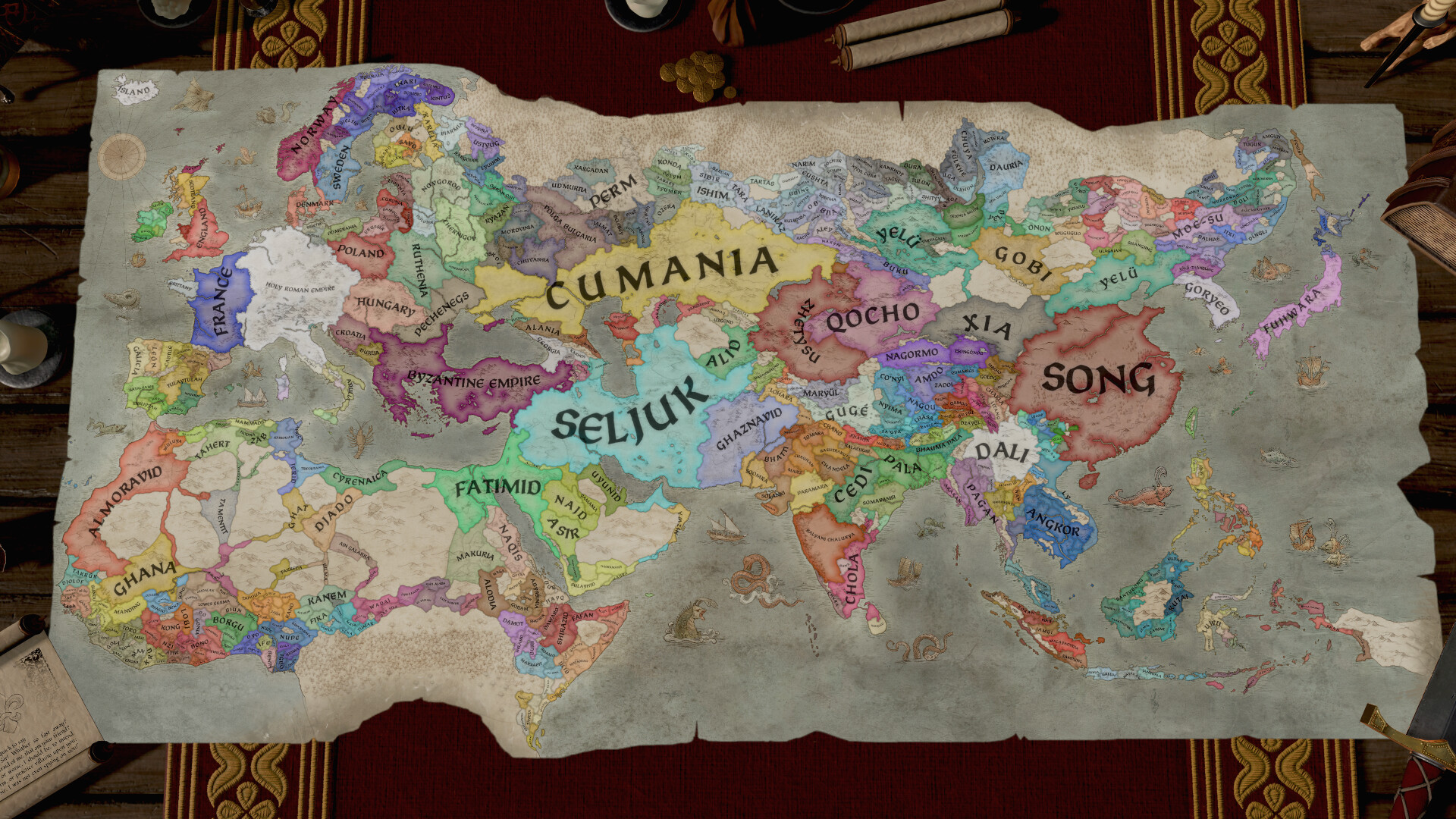
Crusader Kings III does not want to be your strategy game. It wants to be your story generator, your genealogy project, your slow-burn soap opera set against the backdrop of medieval Europe, North Africa, and Central Asia. Paradox Development Preview Room shipped it in 2020 and the game has barely stopped evolving since, accumulating expansions, flavor packs, and rule-set overhauls at a pace that makes reviewing any single version of it feel like photographing a river.
The honest version of a CK3 review is not buy-or-skip. It is more like: here is what kind of chaos you are signing up for, and here is how intelligently the design handles that chaos. Sometimes the answer is: very intelligently. Sometimes it is: not as intelligently as the older game did. Both things are true, and the gap between them is where the interesting arguments live.
A Ruler, Not a Nation
The foundational shift from CK2 to CK3 is that Paradox doubled down on the individual. You are not managing a state. You are managing a person who happens to control a state, and when that person dies, you inherit their heir&#folio-qpuh-gsnf;s problems, their heir&#folio-qpuh-gsnf;s personality traits, their heir&#folio-qpuh-gsnf;s relationships with an extended family that spent the last thirty years plotting against them. The character portrait system communicates this immediately: your ruler has a face, scars, clothes that change with their story. It sounds cosmetic. It is not.
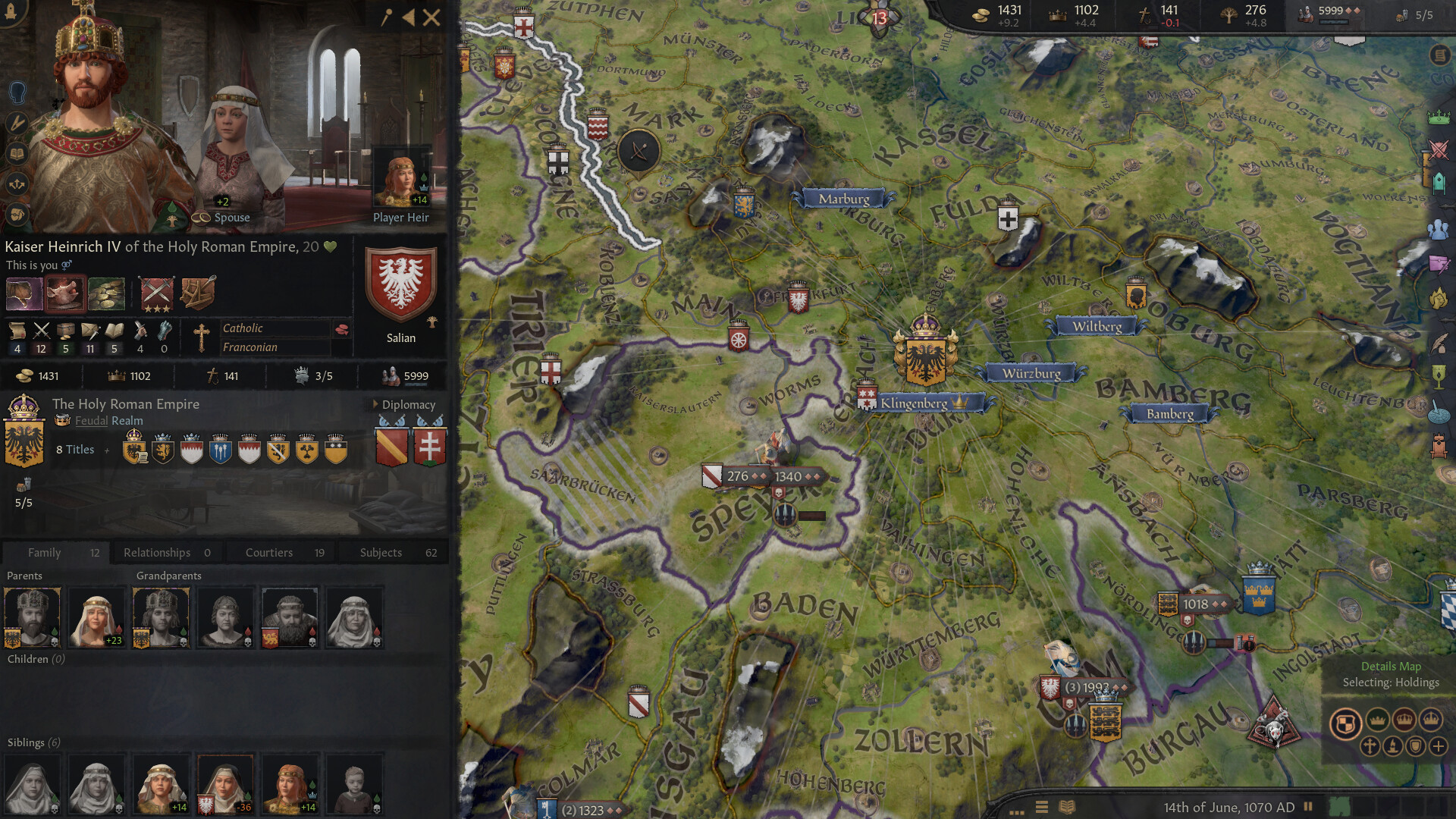 Atmospheric detail in Crusader Kings III.
The trait system does real mechanical work. A Wrathful ruler bleeds stress faster when they cannot act aggressively. A Gregarious one builds hooks on allies naturally, without spending Actions. These are not flavor tags. They shape the decision space in ways that Crusader Kings II handled more abstractly, through stat bonuses that felt less like a character and more like a spreadsheet wearing a hat. CK3 got that part right, and it is worth stating plainly before getting to what it got wrong.
The Men-at-Arms Problem
Combat is CK3&#folio-qpuh-gsnf;s weakest link, and it has been since release. The Men-at-Arms system replaced the old levies-and-retinues model with a cleaner roster of specialized unit types — heavy infantry, archers, siege weapons — that counter each other on paper. In practice, wars resolve through number-crunching that happens off-screen while your character stands somewhere looking worried. There are terrain modifiers. There are commander traits. None of it feels like it has enough mechanical texture to justify the political cost of starting the war in the first place.
CK2, for all its interface clutter, produced battles that felt like events you participated in, partly because the older system had more variable outcomes that cascaded unexpectedly. CK3 battles feel like tax filings. You submit the numbers, you wait, you get a result. The gulf between how rich the political layer is and how thin the military layer is has never been fully bridged, and it creates a lopsided rhythm where the interesting decisions all happen before and after the fighting, never during.
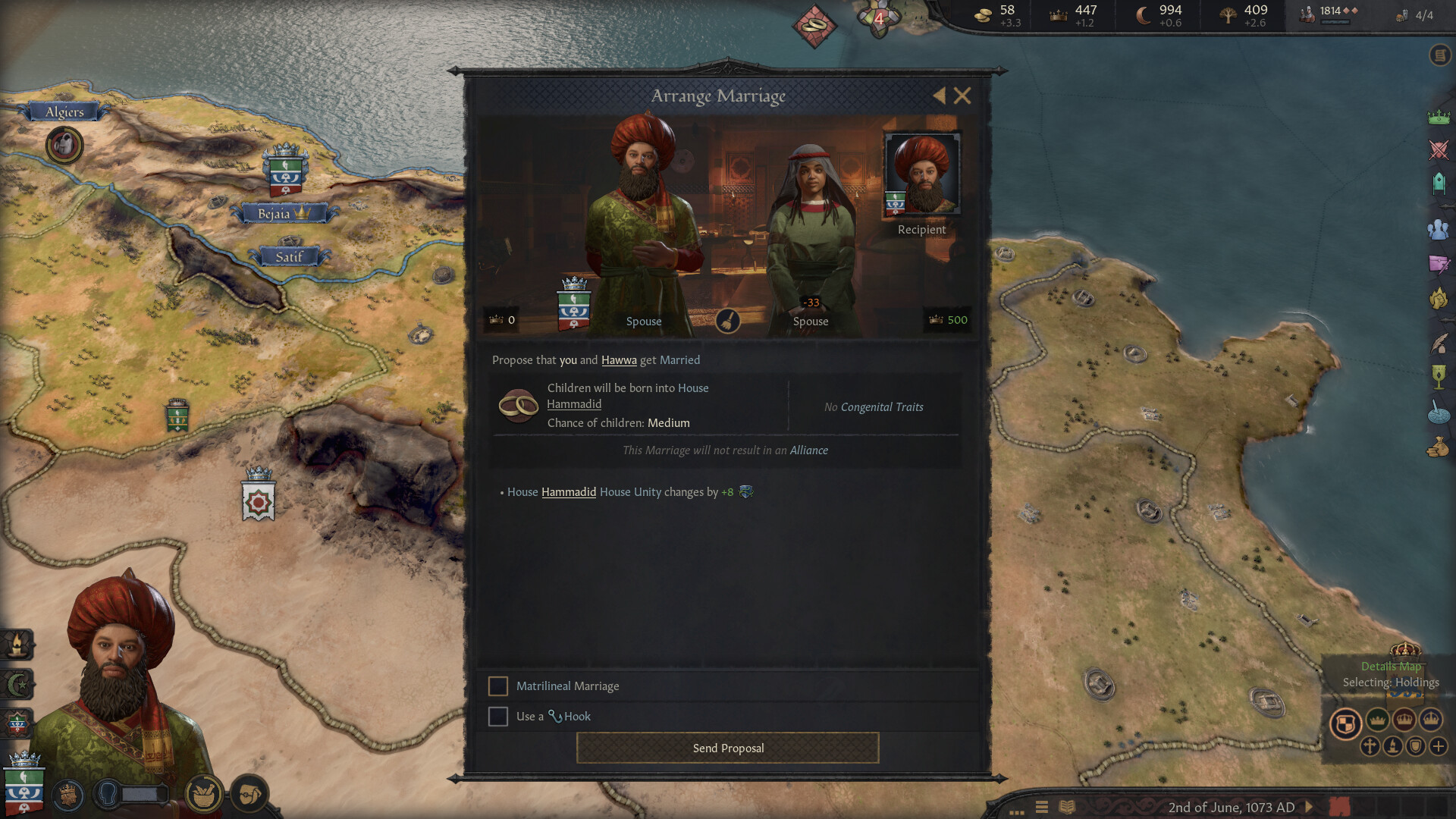 Combat encounter in Crusader Kings III.
Schemes, Hooks, and the Court Intrigue Engine
Where CK3 earns its reputation is in the intrigue layer. The Scheme system — seducing a rival&#folio-qpuh-gsnf;s spouse, recruiting an enemy courtier, fabricating a claim through blackmail — runs on a probability-over-time logic that generates real narrative. You are not executing a plan; you are watching a plan slowly succeed or fall apart while you try not to incriminate yourself. The stress that accumulates when schemes collapse forces you to make decisions about your ruler&#folio-qpuh-gsnf;s mental state that ripple outward into dynasty management. It is genuinely elegant design.
Hooks are the currency that makes this engine run. Owning a secret on someone — their heresy, their affair, their forged lineage — converts into leverage you can spend on demanding support during a vote, extracting a title peacefully, or simply holding over someone&#folio-qpuh-gsnf;s head as a deterrent. The social web this creates is more interesting than anything in competing grand strategy titles right now, including games that have been iterating longer. Paradox built a system that rewards reading the room over reading the map.
The stress-and-lifestyle system attached to all of this is less consistent. The Stress mechanic is meant to humanize your ruler by punishing out-of-character actions, but the coping mechanisms available — throwing a feast, writing poetry, hunting — sometimes feel disconnected from the severity of what caused the stress. Assassinating your eldest son should feel weightier than a -20 Stress offset from a feast a month later. The numbers are tuned for playability, which is reasonable, though it flattens the psychological stakes that the system seems to want to establish.
Dynasty and the Long Game
What separates CK3 from its closest competitors — and from almost everything else Paradox has made — is the dynasty layer. Your dynasty persists across rulers. It accumulates Renown, unlocks Legacies that grant passive bonuses to every future member, and develops a reputation across the medieval world that precedes whoever currently wears your primary title. Losing a good ruler hurts in the short term. Over a dynasty that runs three centuries, that ruler becomes a founding myth, someone whose portrait in the family tree explains why your current heir was born with excellent genes and a talent for diplomacy.
This is where the generational storytelling actually works, mechanically and emotionally. Other games talk about legacy systems. CK3 builds one that has real strategic teeth. A dynasty that invested in the Kin Legacy tree produces more competent courtiers naturally, reducing your reliance on AI vassals who would otherwise occupy important council roles. That is not flavor text. That is a thirty-year investment paying a dividend you planned for when your current ruler&#folio-qpuh-gsnf;s grandfather was still alive. Few games manufacture that kind of long-horizon satisfaction.
The Expansion Treadmill
The expansion model deserves direct scrutiny. CK3&#folio-qpuh-gsnf;s base game is coherent and complete, which is more than could be said for CK2 at launch. The paid expansions have added meaningful systems — the Council politics overhaul, the expanded travel mechanics, the faith customization tools — but the cumulative cost of staying current is significant, and some features that should have been base-game depth are locked behind purchases. The travel system, specifically, changes how you interact with your realm in ways that feel foundational, not supplementary. Selling that as DLC after launch is a defensible business decision that is also slightly annoying.
Free updates have been generous, to be fair. Paradox has pushed substantive balance changes and quality-of-life additions without charging for them. The modding community has further expanded what the base game can do, with total conversions covering everything from Westeros to ancient Rome. If you are buying CK3 in its current state and you pick up the major expansions during a sale, the value per hour is almost absurd. If you are buying piecemeal at full price, you will feel the edges of the base game faster than you should.
The Interface Gap
CK3 is more approachable than CK2. The UI is cleaner, the tooltips are better, the tutorial actually explains what a de jure claim is without requiring a wiki. For players who bounced off the older game&#folio-qpuh-gsnf;s front-loaded complexity, this version removes the wall. What it builds in its place is a subtler barrier: the game looks simpler than it is, which means players get comfortable, make dynasty-destroying decisions without understanding the downstream consequences, and then find themselves vassal to someone they were feuding with three rulers ago. That is not a design failure. That is the game working.
The best version of CK3 is the one you play after you have lost badly at least twice. The first campaign teaches you the interface. The second teaches you what not to do. The third is when the game opens up and you start understanding why someone would sink four hundred hours into managing a fictional bloodline across half a millennium. It is a slow unlock, and some players will bounce before they get there. Paradox probably knows this and has made peace with it.
Crusader Kings III is not a perfect game. The military layer is thin, the expansion costs add up, and the stress system occasionally trivializes what it sets out to dramatize. But the dynasty engine, the intrigue mechanics, and the sheer density of emergent narrative make it the most interesting strategy game Paradox has shipped. The disasters you cause are yours. The dynasty that survives them might be, too.
Editorial scoring
Reader Q&A
How long does it take to finish Your Dynasty, Your Disaster: CK3 Reviewed?
Main story runs around 85 hours depending on how thoroughly you explore. Completionists can spend 2-3× that.
Is Your Dynasty, Your Disaster: CK3 Reviewed good for newcomers to Grand Strategy?
Yes — Your Dynasty, Your Disaster: CK3 Reviewed is a great entry point. The early hours teach the systems gradually and the difficulty curve is reasonable.
Which platform should I play Your Dynasty, Your Disaster: CK3 Reviewed on?
Console version is the most stable on launch. PC version benefits from the modding scene long-term.
Was Your Dynasty, Your Disaster: CK3 Reviewed worth the launch-day price?
Depends on backlog. The replay value justifies the price for genre fans; casual players should wait for a 40%+ discount.
Are there DLCs or expansions worth picking up?
Wait for the Game of the Year edition — it bundles everything at a fair discount.
What did Paradox Development Preview Room get right (and what could be better)?
Paradox Development Preview Room nailed the moment-to-moment loop and the world-building. Pacing in the mid-game and inventory UX have room for improvement.