Celeste Turns the Mountain Into a Mirror
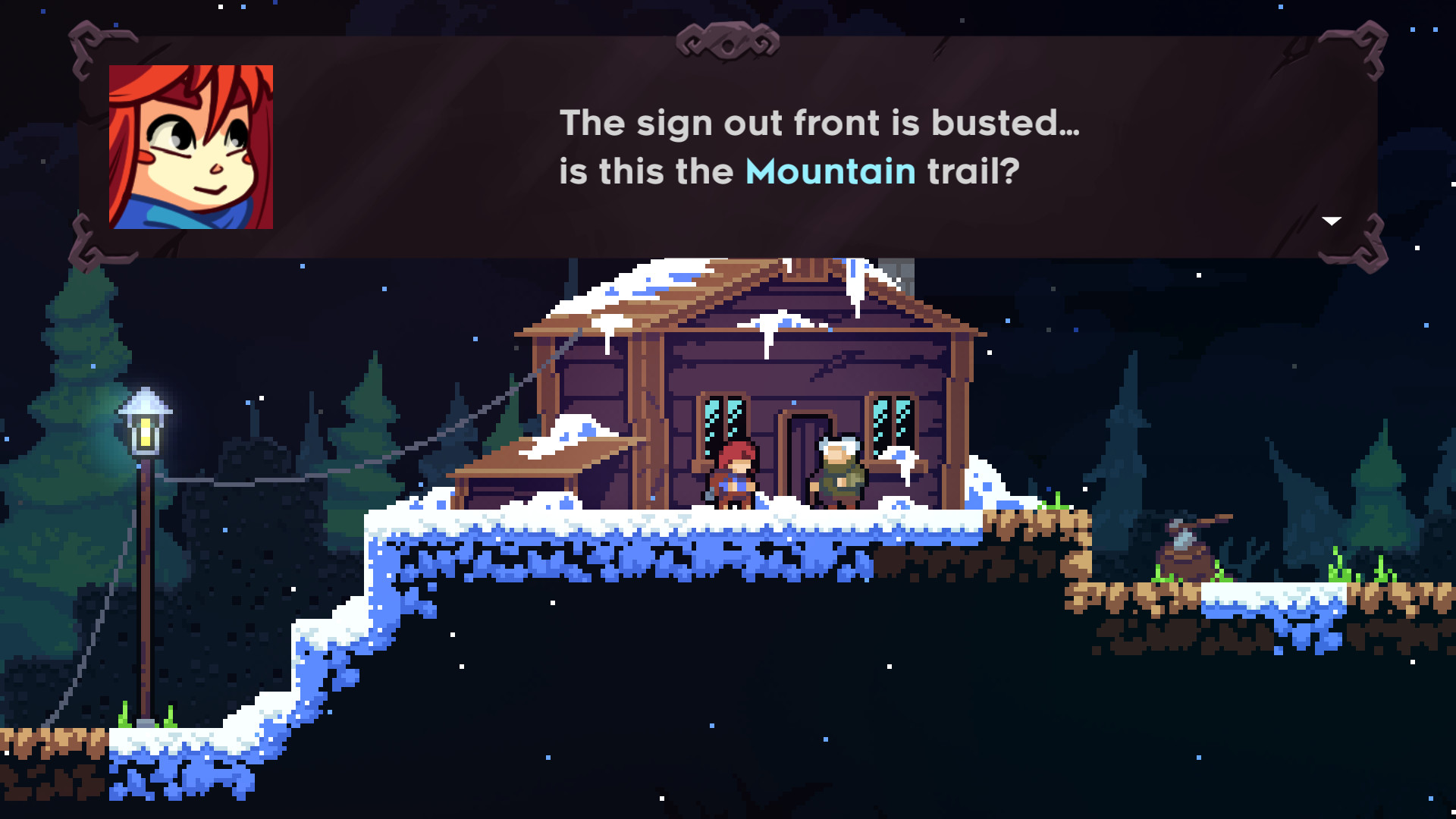
Celeste is a game about climbing a mountain. It is also, very deliberately, a game about not wanting to climb the mountain. That tension — between the act and the feeling underneath it — is what separates it from every other precision platformer on the market. Madeline, the protagonist, does not arrive at Celeste Mountain with a clean training arc or a mentor figure. She arrives with anxiety, avoidance patterns, and a vague, self-defeating certainty that this is a terrible idea. The mountain does not disagree with her.
Developed by Maddy Thorson and Noel Berry under the Extremely OK Games banner, Celeste released in 2018 and has spent the years since accumulating a reputation it fully earns. It sits in a category occupied by Hollow Knight and Shovel Knight — games where the aesthetic is modest but the mechanical precision is severe. Unlike those, Celeste does not lean on combat. There are no enemies to fight, no weapons to upgrade, no builds to manage. What it offers instead is a sustained argument, made through level design and writing in equal measure, that difficulty and emotional honesty can reinforce each other.
What the Controls Actually Do
Madeline moves with three core abilities: run, jump, and a single midair dash that recharges on landing or when touching a crystal heart refill point. That is the vocabulary. Everything the game asks of you — across hundreds of individual screen-sized rooms — is built from those three verbs. The design restraint here is almost aggressive. No double jump. No wall-climb meter. No unlockable movement options until very late, and even those are context-specific.
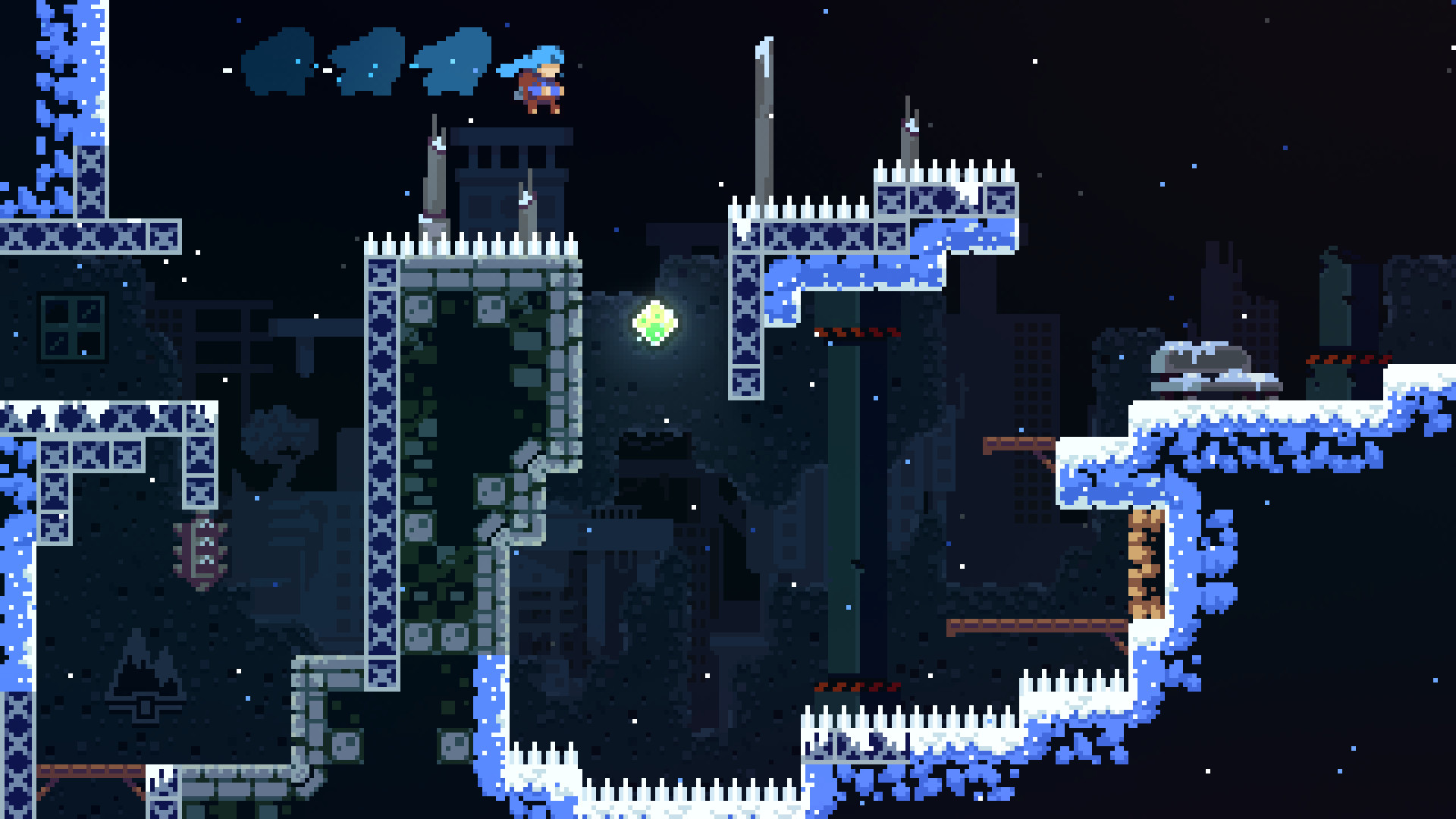 Scene from Celeste.
The precision required is real. Many rooms will kill you five times before you parse what they want. The dash mechanic in particular has a diagonal component that takes time to internalize — hitting a down-left dash into a jump at exactly the right frame is not something you do consciously at first, it is something your hands eventually learn. Celeste seems to understand this. Deaths are nearly instantaneous to recover from, the respawn is fast enough that failure rarely breaks concentration, and the camera is tight enough that you almost always know what went wrong. It is a loop engineered to keep you in the problem rather than outside it.
There is also Assist Mode, which allows players to adjust game speed, grant infinite dashes, or toggle invincibility. It carries no in-game penalty or judgment. No asterisked completion, no separate save file. The game simply lets you use it, and says nothing condescending about it. For a precision platformer to ship with that system and not bury it in a disclaimer is, quietly, a political act.
Level Design as Argument
Each chapter recontextualizes the movement system without fundamentally changing it. One chapter introduces a mechanic where Madeline clings to and launches from moving platforms that behave like living creatures, forcing you to time dashes around their rhythm rather than your own. Another strips away reliable ground entirely, building sequences out of crumbling ledges and spring-loaded bumpers. The game never stops teaching, but it teaches almost entirely through placement rather than instruction.
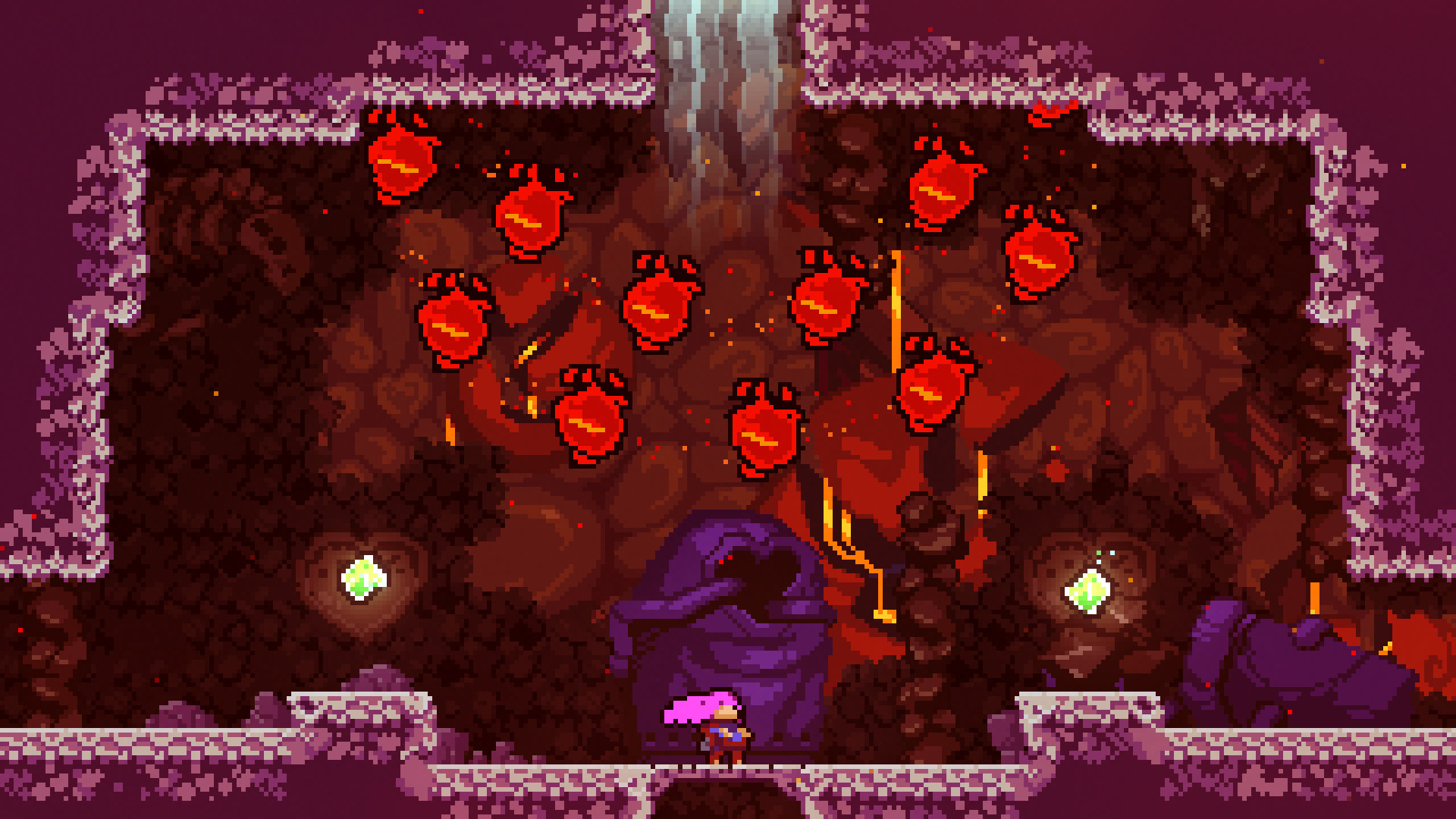 Scene from Celeste.
The B-side and C-side chapters, unlocked by finding collectibles, are where the design becomes genuinely punishing. These are remixed versions of each chapter&#folio-qpuh-gsnf;s rooms, stripped down to their most demanding elements. If the main path is a difficult conversation, the B-sides are an interrogation. They exist for players who want the movement to become something closer to muscle memory, a physical language they can speak fluently. Not everyone will want to go there. That is fine. The main path alone is a complete experience.
The Writing, Which You Cannot Skip
Celeste&#folio-qpuh-gsnf;s narrative is not delivered in cutscenes you watch — it is interwoven with the level structure. The dialogue scenes between chapters are short, specific, and resistant to the kind of fantasy-epic grandiosity that afflicts games which take themselves too seriously. Madeline&#folio-qpuh-gsnf;s conversations with Theo, a fellow climber she meets partway up, have a texture to them that reads as observed rather than constructed. He is curious without being annoying. She deflects without being rude. The relationship earns its emotional weight across small moments.
The central conflict — Madeline&#folio-qpuh-gsnf;s confrontation with a manifestation of her own self-doubt, a character the community calls Part of Her — is where the game takes its biggest swing. What could have been a hollow metaphor becomes something more specific when the game commits to it mechanically. The sections where Part of Her pursues Madeline through levels are anxiety reproduced as game design: the rules change, the familiar tools behave unexpectedly, the safe ground you thought you understood suddenly isn&#folio-qpuh-gsnf;t. Whether this lands will depend partly on how much of yourself you bring to it. I found it more convincing than I expected, and I went in skeptical of it.
The Soundtrack as a Third Structural Element
Lena Raine&#folio-qpuh-gsnf;s score is not incidental to the experience. It is doing load-bearing work. Each chapter has a distinct musical identity — the opening chapters are warm and synth-driven, while the later ascent areas shift into something more dissonant and stretched, as if the mountain&#folio-qpuh-gsnf;s atmosphere is thinning along with Madeline&#folio-qpuh-gsnf;s confidence. The music does not punctuate the narrative from outside it. It is part of the pacing.
The track that accompanies the final ascent is probably the most discussed piece of game music from the last decade that is not from a FromSoftware or Supergiant title. It builds in layers synchronized to Madeline&#folio-qpuh-gsnf;s actual progress through the level, adding instruments as she climbs. The synchronization is not a gimmick — it is a structural choice that makes the music feel responsive in a way that static orchestral scores cannot achieve. Whether it made you feel anything is a personal question. Mechanically, it is one of the smarter things Raine and the developers pulled off.
Where It Is Less Than Perfect
Some of the mid-game chapters outstay their welcome slightly. The chapter set inside the hotel, which introduces a mechanic around dashing through ghosts to collect their residual energy, works well in isolation but extends long enough that it starts to feel like it is testing endurance more than skill. There is a fine line between a chapter that is long because it has more to say and one that is long because the designers had more ideas and did not edit aggressively enough. The hotel chapter lands just on the wrong side of that line a few times.
The optional strawberry collectibles are also, mostly, an excuse for completionists rather than an integral part of the design. Collecting them requires finding and reaching them within a single room run without dying — lose the run, lose the strawberry. Some of the placement is clever. Others feel arbitrary. They do not damage the game, but they are the section where you can most clearly see the team throwing in extra challenge without always asking what purpose that challenge serves.
The Summit
What Celeste does that very few games attempt is make the difficulty feel load-bearing to the theme. The hours you spend failing, the reflexes you develop, the specific frustrations of learning each room — they are the point. When Madeline reaches the top, you have done something with your hands that mirrors what the story is telling you about the mind. That structural alignment is not accidental, and it does not happen in games that treat their mechanics and their writing as separate departments.
Celeste is not the hardest precision platformer available. Kaizo Mario hacks exist. Super Meat Boy exists. What Celeste offers that those do not, at least not consistently, is a reason to keep going that is not purely about ego or completion. The mountain is a mirror, as the title of this piece rather plainly states. What you see in it is up to you. But the reflection is genuinely there, and it was put there on purpose, by people who knew exactly what they were building.
Editorial scoring
Reader Q&A
How long does it take to finish Celeste Turns the Mountain Into a Mirror?
Main story runs around 60 hours depending on how thoroughly you explore. Completionists can spend 2-3× that.
Is Celeste Turns the Mountain Into a Mirror good for newcomers to Precision Platformer?
Yes — Celeste Turns the Mountain Into a Mirror is a great entry point. The early hours teach the systems gradually and the difficulty curve is reasonable.
Which platform should I play Celeste Turns the Mountain Into a Mirror on?
PC version offers the highest fidelity if your rig can handle it. Console versions are polished out of the box.
Was Celeste Turns the Mountain Into a Mirror worth the launch-day price?
If you&#folio-qpuh-gsnf;re a fan of Maddy Makes Games, yes. If you&#folio-qpuh-gsnf;re new to the studio, a sale price is more comfortable.
Are there DLCs or expansions worth picking up?
Wait for the Game of the Year edition — it bundles everything at a fair discount.
What did Maddy Makes Games get right (and what could be better)?
Maddy Makes Games nailed the moment-to-moment loop and the world-building. Pacing in the mid-game and inventory UX have room for improvement.