Marcus Holloway Owns San Francisco — If You Let Him
Watch Dogs 2 came out in 2016 and most people who played it treated it like a palate cleanser after the first game&#folio-qpuh-gsnf;s grey, humorless Chicago. They were right to. Ubisoft San Francisco built something looser, funnier, and mechanically messier — and that messiness is exactly where new players get lost. Marcus Holloway is not Aiden Pearce. He does not want to be. The sooner you stop playing him like a cover-shooter protagonist and start playing him like someone who genuinely believes hacking is funnier than shooting, the better the game gets.
This guide is not trying to hold your hand through every mission. It is trying to correct the three or four habits that make Watch Dogs 2 feel worse than it is. The hacking toolkit is deeper than the tutorial communicates, the open world rewards patience in specific ways, and there is a right order to spend your research points that the game never quite tells you. Start here.
Stop Shooting. Seriously, Stop.
The game has guns. It also has a stealth system, a drone, a RC car called the Jumper, and a remote-controlled boat. The guns are the worst option in almost every scenario. Marcus is not built for prolonged firefights — his health pool is thin, cover-to-cover movement is sticky compared to something like The Division, and enemy reinforcements escalate fast once alarms trigger. If you keep defaulting to the pistol, you will spend more time reloading at checkpoints than actually progressing.
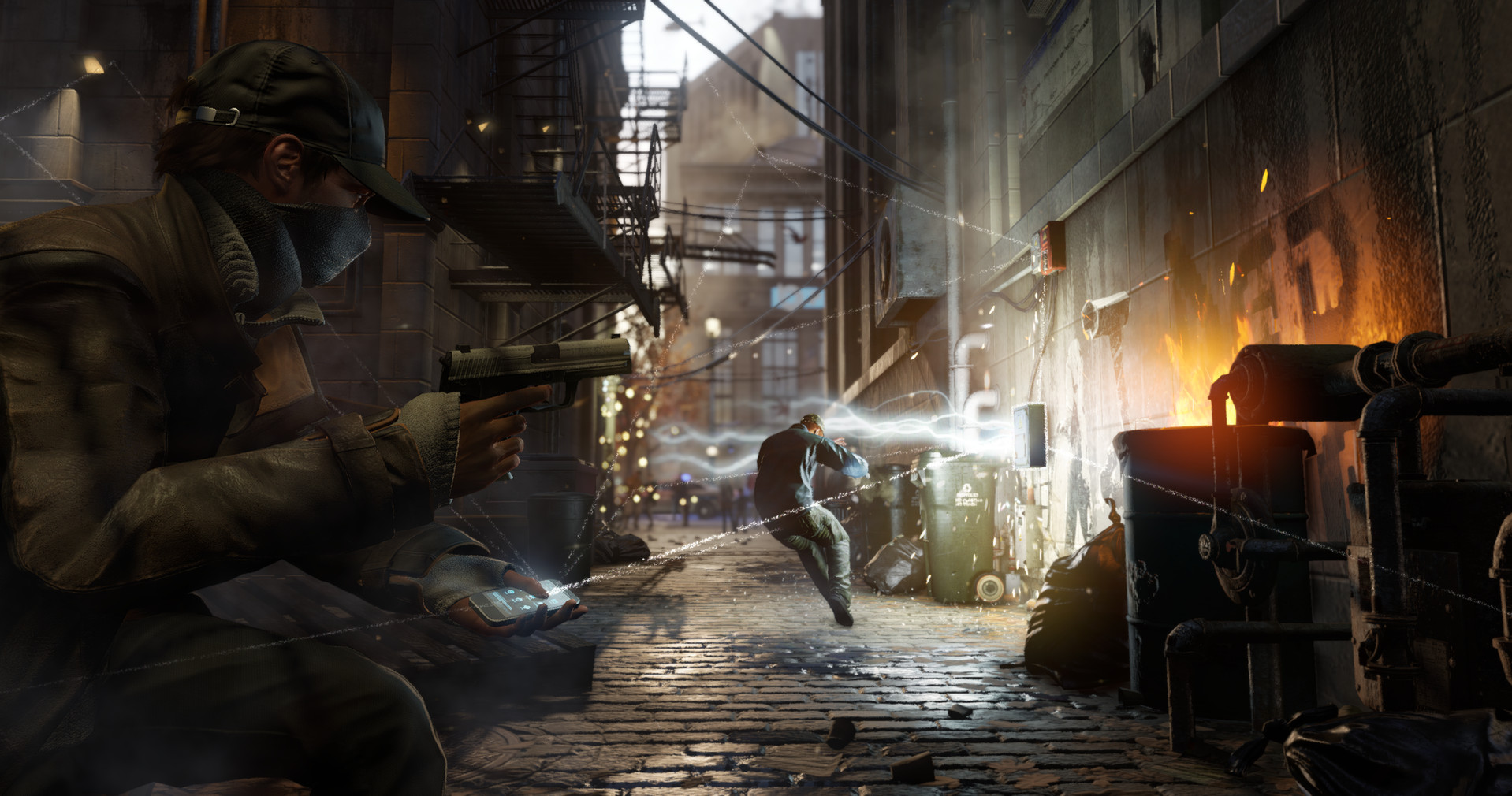 Scene from Watch_Dogs 2.
What the game actually rewards is the combination of the Jumper and environmental hacking. Send the RC car into a restricted area, use it to interact with access points, and you can complete entire mission objectives without Marcus ever entering the building. The Jumper can reach vents, crawl under fences, and jack into terminals that trigger cutscenes. There are missions in the later half of the game — particularly the operations targeting Blume and Nudle — where a competent Jumper run cuts the mission time in half and eliminates every combat encounter entirely.
When you do have to fight, use the environment. Forklifts, generators, and gas tanks are all hackable mid-combat. A junction box near a cluster of guards is worth more than three bullets. This is not a new design idea — Deus Ex was doing it in 2000 — but Watch Dogs 2 stages its restricted areas specifically to make environmental kills viable if you scout before engaging.
Research Points: What to Unlock First
The research tree is split into Hack, Stealth, and Mayhem branches. Most new players spread points evenly, which means they end up with nothing fully unlocked for the first four or five hours. Pick a lane. For a non-lethal stealth approach — which is the approach the game&#folio-qpuh-gsnf;s tone is built around — the Hack branch gives you the most return early. Specifically, the upgrades that let you trigger multiple device hacks in sequence and the one that extends your remote-hack range are transformative. Both come reasonably early in the tree.
The Jumper upgrade that lets it jump higher is also worth prioritizing. It sounds minor. It isn&#folio-qpuh-gsnf;t. A huge number of access points are on raised platforms or behind obstacles the base Jumper cannot clear. Without the upgrade, you hit invisible walls constantly. With it, a significant chunk of previously blocked routes open up. The drone gets less use in the early game but becomes essential for scouting larger compounds later, so invest there once the Jumper is sorted.
The City Is a Tool, Not a Map
San Francisco in Watch Dogs 2 is not just aesthetically distinct from other open worlds — it is mechanically interactive in ways that players often ignore. Traffic lights, bridges, and construction equipment can all be hacked from a distance. This matters most during chases. Police pursuit in this game can escalate from manageable to catastrophic quickly, and the instinct is to drive faster. The better move is to hack a bridge while a police cruiser is crossing it, or trigger a red light at an intersection to cause a pileup behind you. The city is a defensive weapon.
The same logic applies to infiltration. Before Marcus physically enters any restricted zone, spend two minutes with the drone or camera network to map the interior. Every restricted area has at least one camera you can jump between, and those cameras often connect to other cameras, which eventually give you a complete picture of guard positions and patrol routes. It is slower upfront. It saves significant time later. Splinter Cell players will find this rhythm familiar; everyone else will need to unlearn the urge to just walk in.
Also worth noting: the NetHack view — activated with a button press that highlights hackable objects in the environment — should be treated as a permanent second layer of vision. New players toggle it occasionally. Experienced players run most of the game with it in mind constantly, cycling in and out to read what is available before committing to any movement.
Follower Missions Are Not Side Quests
Watch Dogs 2 gates several story missions behind a follower count — a stand-in for the kind of public support DedSec is supposedly building. The number goes up when you complete operations, side operations, and a category of missions triggered by finding specific items in the world. New players often treat the follower-gated missions like an annoyance and grind whatever is closest to push the number up. That works, but it misses a lot of the game&#folio-qpuh-gsnf;s better writing.
The side operations, specifically, are where Watch Dogs 2 takes most of its risks. The main story plays it relatively safe — tech company satire, surveillance state critiques you have heard before. The side content gets stranger. There is a mission chain involving a cult that becomes one of the more memorable sequences in any Ubisoft open world from that era, not because it is shocking but because it commits to a specific absurdist logic for longer than you expect. These are worth doing for their own sake, not just for the follower count.
Multiplayer Invasions and How to Survive Them
By default, Watch Dogs 2 allows other players to invade your session and hack you, which triggers a tailing sequence where the invader wins by staying close long enough. This can be turned off in the options, but leaving it on is worth the occasional interruption — the tension it creates is something the campaign rarely matches. When you are being invaded, stop moving fast. The instinct is to run. Running makes you easier to spot because the invader can see a pursuit indicator that responds to distance changes. Walk casually, blend into foot traffic, and scan everyone around you.
When you are the one doing the invading — and the game encourages you to try — patience is the mechanic. You need line of sight and proximity without being identified. The best approach is to get into position before initiating the hack, then stay still. Most targets panic and move, which makes them easier to follow at a distance. It is a strange little asymmetric game tucked inside the open world, and it holds up better than the equivalent mode in the original Watch Dogs.
One Thing the Game Does Not Tell You
The Bounty Hunter mode — where players can be contracted to hunt you down when you commit enough mayhem — is also opt-in to some degree via settings, but the game&#folio-qpuh-gsnf;s hint system never clearly explains how your heat level connects to it. If you want to experiment with high-chaos play without being hunted by other players, check the Online Options menu early. It is not hidden, but it is not surfaced well either.
Watch Dogs 2 is messier than it should be in places — the driving physics have always been divisive, some of the later story missions recycle restricted-area structures too liberally, and the ending lands with less impact than the setup deserves. But the core loop, when you are using Marcus&#folio-qpuh-gsnf;s full toolkit instead of just the gun, is genuinely good. Better than the series got credit for. Put down the pistol, send in the Jumper, and let the city do the work.
Reader Q&A
Is this guide spoiler-free?
We avoid story spoilers. Mechanics and systems are explained directly, but plot beats are not covered.
How current is this guide?
Updated for the most recent patch as of June 2026. Major balance changes are noted inline.
Do I need DLC for these strategies to work?
No. Everything covered here applies to the base game. Where DLC content is referenced, we mark it clearly.
Will following this guide work on hardest difficulty?
Mostly — yes. A few strategies become tight on hardest difficulty; we flag those where relevant.